

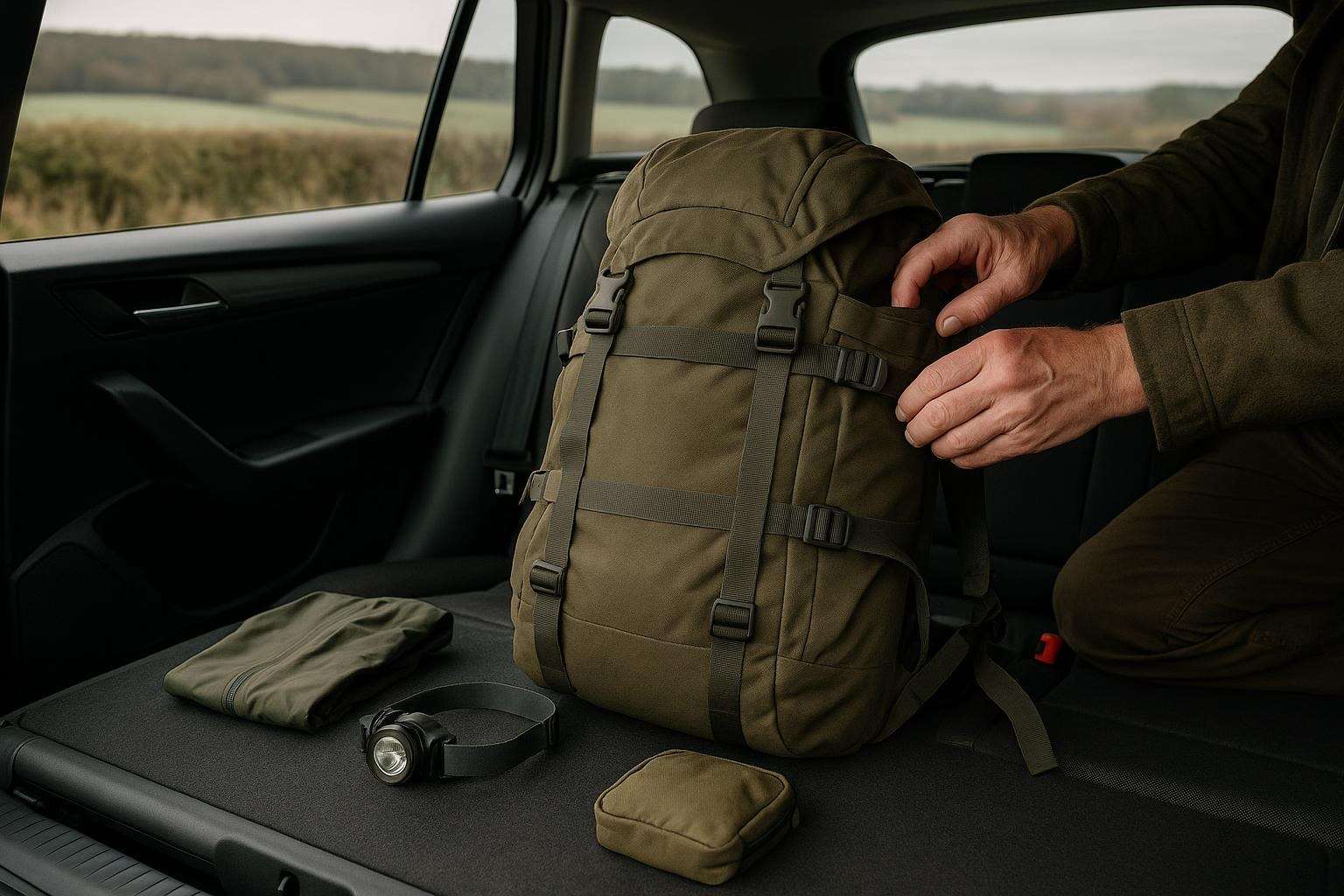
A permission day can look simple on paper: a short route, a favourable weather window and a rucksack that seems almost ready to go. In practice, small omissions become awkward quickly. A flat battery, wet spare layer, forgotten identification document or unsuitable footwear can turn a manageable outing into a difficult one.
The useful pre-departure question is not "What else can I fit in?" It is "What needs to work, what helps me return safely, and what serves no real purpose?" A brief gear audit answers those questions before they matter in the field. It also gives you a chance to reconsider the ground, the forecast, nearby people, the quarry and the responsibilities that come with ethical hunting in the UK.
Make the plan before making the pack
Start with the permission and the land, not the equipment. Confirm that permission is current, check the boundaries and review the intended access route. Do not assume familiar ground is unchanged. Forestry work, flooding, livestock movements, blocked tracks or a new public access arrangement may have altered the safest way in or out.
If another person is coming, settle the practical details in advance. Agree where you will meet, how you will contact one another and when someone at home should expect an update. A check-in plan is especially useful where mobile coverage is unreliable or the route may take longer than expected.
The forecast should influence the load rather than merely appear as a quick glance at a phone. Rain, wind, heat, low cloud and poor visibility change the demands on clothing, navigation and judgement. A thin jacket may be perfectly adequate for a sheltered walk but a poor choice on exposed ground. Conversely, carrying a full shelter system for a brief outing close to the vehicle may add bulk without improving the plan. Consider the likely conditions, not just the temperature at the start.
Check current UK hunting regulations and any local restrictions before leaving. Requirements can vary according to species, land, season and method, and official guidance can change. An old note, forum comment or verbal assumption is not a dependable substitute for the relevant current government or statutory source. If the legal position is uncertain, put the outing on hold until it is verified.
Judge equipment by what happens when it fails
Lay everything out where you can inspect it. For each item, ask three practical questions: What problem does it solve? What is the consequence if it stops working? Is there a smaller, stronger or shared alternative?
This exercise often exposes the difference between preparation and habit. Navigation aids, communication, weather protection, water, food, first aid and equipment required by law or by the planned activity come first. A second item is justified when it covers a genuine failure or a separate task. Two torches with weak batteries are not a useful backup if neither has been tested. One dependable light with a tested spare power source may be the better arrangement.
Look at the equipment rather than remembering that it was fine last time. Run the zips, inspect straps, examine waterproof layers and check footwear for wear or damage. Switch on the headtorch in a dark room. Confirm that the phone is charged and can make an emergency call in the areas you expect to visit, while recognising that reception and battery life are not guaranteed. Where either is uncertain, carry a backup navigation method and know how to use it.
Keep high-priority items reachable. A first-aid kit, torch, navigation aid or emergency layer is of limited value if it is buried beneath the whole pack. Organisation is part of readiness, not just a matter of convenience.
Weight matters, but a lighter bag is not automatically a safer one. Removing a first-aid kit to save space is a poor decision. Removing duplicate clothing that has no distinct use may be sensible. Good lightweight hunting gear is dependable, repairable and matched to the outing; it is not simply the item with the lowest published weight.
Dress for the day you may have, not the one you want
A layering system gives you options as effort and conditions change. A moisture-managing base layer, an insulating layer and weather protection can be added or removed without forcing you to commit to one heavy garment. If becoming wet and cold would create a serious problem, avoid cotton next to the skin and protect a dry spare layer inside the pack. A layer fastened to the outside can absorb rain before it is needed.
Footwear deserves an equally honest check. Match it to the distance, terrain and expected moisture. Comfortable boots in a shop may create pressure points after several hours, and deep tread does not remove the need for careful movement on steep, muddy or slippery ground. Check the laces, insoles and waterproofing before the day begins rather than discovering a fault halfway along the route.
Small items can contribute to safety without taking much room. Gloves help preserve dexterity, eye protection is useful in dense vegetation and a whistle provides a simple way to attract attention. These are supporting measures, not replacements for route planning, restraint or responsible firearm handling where firearms are lawfully involved.
Include the ground and the quarry in the audit
The kit is only one part of the decision. Ask whether the intended activity still makes sense given the visibility, access, ground conditions and likely presence of other people. If identification is uncertain, animal welfare could be compromised or the route has become unsafe, changing the plan or going home empty-handed may be the responsible choice.
Ethical hunting is not defined by whether a shot is taken. It includes confirming identification, respecting the limits of the permission, making careful follow-up decisions and avoiding unnecessary disturbance. Consider nesting areas, livestock, watercourses and sensitive vegetation. Follow the land manager's instructions about gates, vehicles and routes, and take public access into account.
Low-impact conduct is usually made up of ordinary actions: close every gate, avoid creating erosion, report hazards and leave the ground usable for the next visitor. Pack out food wrappers, damaged tape and used consumables. Nothing should be discarded because it is small or inconvenient.
A compact repair kit can help here. A few suitable cable ties, tape and a small cutting tool may repair a torn strap or loose buckle and prevent a temporary fault from becoming abandoned litter. Repairing something is not a reason to continue when it is no longer safe. Know the difference between a temporary fix and equipment that should be withdrawn.
Use a repeatable door check
The final check should be brief enough to use every time, but concrete enough to catch omissions. Before leaving, confirm:
– Permission, boundaries, access arrangements and current regulations.
– Forecast, daylight, route and the agreed check-in plan.
– Phone, navigation aids, torch and spare power source.
– Clothing and footwear suited to the terrain and expected conditions.
– Water, food, first aid and emergency contact details.
– Required equipment secured, functional and carried safely.
– Identification, likely decisions and animal-welfare considerations.
– Plans for gates, litter, livestock, public access and habitat impact.
Do one last review at the vehicle. Remove anything that has no real job, but do not strip away the basic resilience needed when a route takes longer, the weather changes or an item fails. The right load is not the smallest possible load. It is the one that supports calm decisions without carrying needless duplication.
That is the purpose of a UK hunting gear audit: protecting the person carrying the equipment, reducing avoidable disturbance and leaving enough capacity for sound fieldcraft. Treat every outing as a new assessment rather than a routine box-ticking exercise, and recheck the legal position whenever the species, land, season, method or circumstances change.